
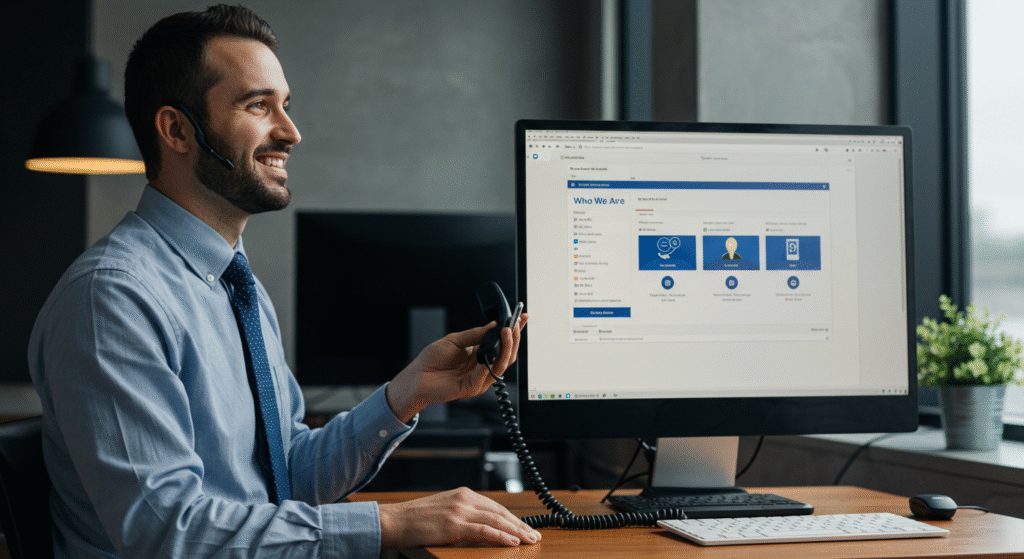
The landline switch-off is usually talked about as a chore: something you have to do before January 2027. But for most small businesses, moving to a modern phone system is the biggest upgrade their phones have had in twenty years. Here are the features you get when you leave the landline behind, and why they matter day to day.
1. Your office number on your mobile
Install an app and your mobile becomes an extension on the office system. You can make and take calls using the business number, so customers never see your personal number and you can switch the app off when you finish for the day. We cover this in more detail in our post on using your office number on your mobile.
2. Work from anywhere
Desk phones, mobiles and laptops all connect to the same system over the internet. Someone working from home, on site or on the train is on the same phone system as the office. Transferring a call to them is the same as transferring it across the room.
3. A professional welcome menu
An auto attendant greets callers and routes them: “press 1 for sales, 2 for support”. It makes a small business sound organised and gets callers to the right person first time, without someone on reception having to answer every call.
4. Call queues and ring groups
Instead of one phone ringing out, calls can ring a group of people at once, in turn, or join a queue with hold music and position announcements. Fewer missed calls means fewer lost customers.
5. Voicemail to email
Voicemails arrive in your inbox as audio files, and on many systems as written transcripts. You can listen on any device and forward a message to the right person in seconds.
6. Call recording
Record calls for training, quality or to settle disagreements about what was said. Recordings are stored centrally and searchable, rather than relying on someone’s notes.
7. Opening hours and holiday routing
Set office hours once and the system automatically sends out-of-hours calls to voicemail, an on-call mobile or a message. Bank holidays and Christmas closures can be scheduled in advance.
8. See who is available
Presence shows whether colleagues are free, on a call or away, so you know before you transfer a call. Many systems also include team chat alongside calls.
9. Reports on your calls
See how many calls you get, when they peak, how long people wait and how many go unanswered. It is the first time many businesses can actually measure their phones, and it often shows exactly when they need more people answering.
10. Connect to the tools you already use
Modern systems can integrate with Microsoft 365, Microsoft Teams and popular CRM systems, so a customer’s record pops up when they call and calls are logged automatically. Which integrations are available depends on the platform.
11. AI features
The newest systems are adding AI: transcripts and summaries of recorded calls, sentiment analysis, and AI receptionists that can answer and route calls. These are still developing and usually depend on the edition you choose, but they are moving fast. We explain what is available now in AI in business phone systems.
12. Add or remove users in minutes
A new starter needs a phone? It is a setting, not an engineer visit. Someone leaves? Remove them and stop paying. No new lines to order, no waiting for installation.
13. Keep your numbers, add new ones
You keep every number you have today. You can also add numbers for other areas, such as a Nottingham, Glasgow or London number, all ringing into the same system.
14. Lower and more predictable costs
Line rental and call charges are replaced with a simple per-user monthly price. For most small offices it is cheaper than what they pay now. With us it is £15 per user per month, including the system, hosting, management and support.
What you need to get these features
A reliable internet connection and a modern phone system, which for most businesses means a hosted business phone system. If you already have a phone system you are happy with, SIP trunks can replace your lines while you keep it, although some features depend on the system itself.
See what your phones could do
Tell us how you use your phones today and we will show you what would change, and what it would cost, on the first call.